

Unconstrained gravity field model Tongji-GOGR2019S derived from GOCE and GRACE data
-
摘要:
本文在法方程层面融合GOCE卫星的Vxx、Vyy、Vzz和Vxz重力梯度分量观测数据和GRACE卫星观测数据,采用直接法解算了220阶次的重力场模型Tongji-GOGR2019S.首先利用ⅡR带通滤波器在5~41 mHz的重力梯度带宽范围内对约24个月的GOCE重力梯度观测方程进行无相移滤波处理,并组成解算220阶次重力场模型的法方程,各梯度分量根据相对于参考模型统计精度进行定权;然后与13.5 a GRACE数据建立的180阶次Tongji-Grace02s重力场模型的法方程进行叠加,解算了220阶次的无约束纯卫星重力场模型Tongji-GOGR2019S.利用EIGEN-6C4重力场模型、GNSS/水准数据、DTU15重力异常数据以及欧洲区域似大地水准面模型EGG2015等数据对Tongji-GOGR2019S模型精度进行全面的检核评定,结果表明:引入GOCE卫星梯度数据后,高于72阶的位系数精度优于Tongji-Grace02s模型,Tongji-GOGR2019S模型的整体精度接近同阶次的DIR-R6等GOCE卫星第6代模型.
-
关键词:
- 全球重力场模型 /
- GOCE /
- GRACE /
- Tongji-GOGR2019S
Abstract:In this study, a static gravity field model Tongji-GOGR2019S up to degree and order 220 was derived from a combination of GOCE and GRACE observations on normal equation level. When generating the corresponding normal equation from GOCE, the direct approach was used to process approximately two years of gradient component data (Vxx, Vyy, Vzz and Vxz). Prior to deriving the GOCE normal equation, a band-pass ⅡR filter was applied to decorrelate both sides of SGG observation equation in the frequency band between 5 mHz and 41 mHz. To derive the normal equation, a data weighting technique was employed for each gradient component according to the corresponding standard deviation w.r.t. the a priori gravity field model. Further incoporating the GRACE normal equation regarding Tongji-Grace02s up to degree and order 180 from 13.5-year GRACE data into the derived GOCE normal equation up to degree and order 220, we successfully produced Tongji-GOGR2019S complete to degree and order 220. To comprehensively evaluate the quality of the derived model, Tongji-GOGR2019S was compared to the state-of-the-art gravity field model EIGEN-6C4 as well as geoid model EGG2015, and validated with GNSS/leveling data and DTU15 marine gravity data. The analyses allow us to derive the following conclusions:due to the use of GOCE data, the accuracy of Tongji-GOGR2019S model has been effectively improved beyond degree 72, and the accuracy of Tongji-GOGR2019S model is closer to the GOCE R6 models at the same degree.
-
Key words:
- Global gravity field model /
- GOCE /
- GRACE /
- Tongji-GOGR2019S
-

-
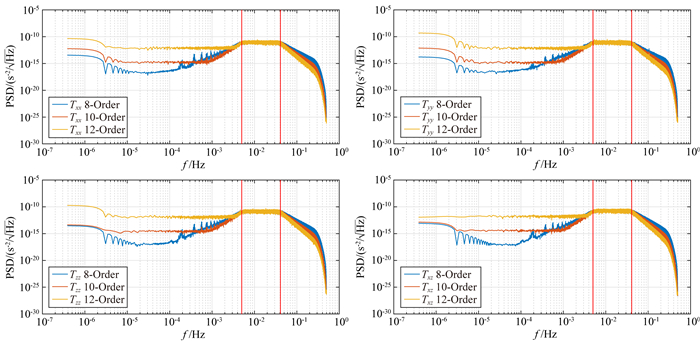
图 1
不同阶IIR带通滤波器滤波结果比较
Figure 1.
Comparison of filtering results with different order IIR bandpass filters
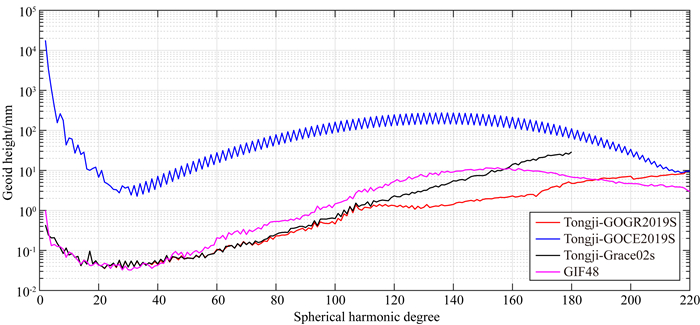
图 2
Tongji-GOGR2019S等模型与EIGEN-6C4模型比较大地水准面阶误差
Figure 2.
Comparison of geoid height degree error from Tongji-GOGR2019S and other models vs. EIGEN-6C4 model
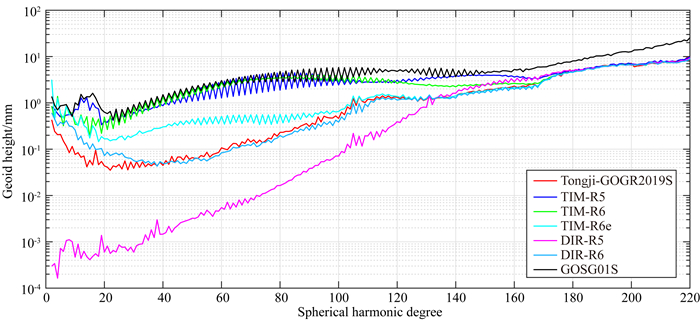
图 3
Tongji-GOGR2019S及其他GOCE模型与EIGEN-6C4模型比较大地水准面阶误差
Figure 3.
Comparison of geoid height degree error from Tongji-GOGR2019S and other GOCE models vs. EIGEN-6C4 model
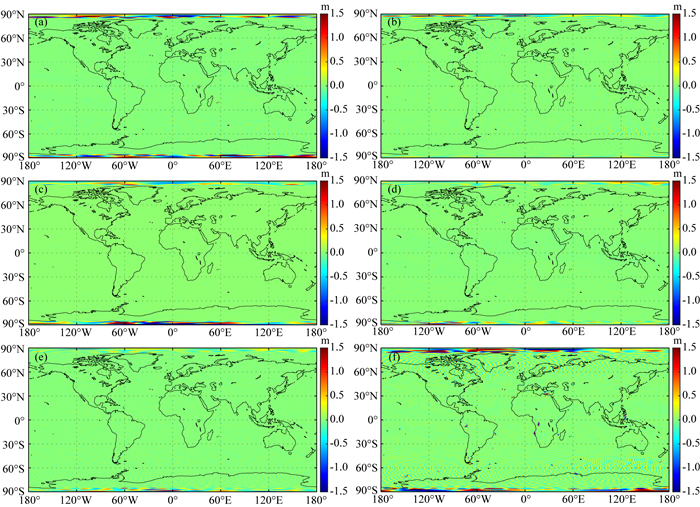
图 4
截断至220阶各重力场模型与DIR-R6模型全球大地水准面差值
Figure 4.
Geoid height differences of different models vs. DIR-R6(up to 220 degree/order)
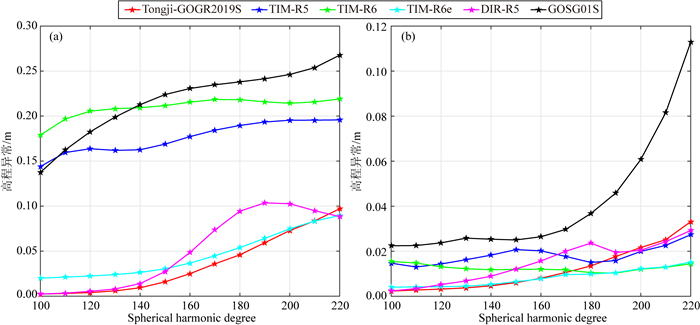
图 5
各模型与DIR-R6模型高程异常差值统计结果
Figure 5.
Statistical results of height anomaly differences between different models and DIR-R6 model
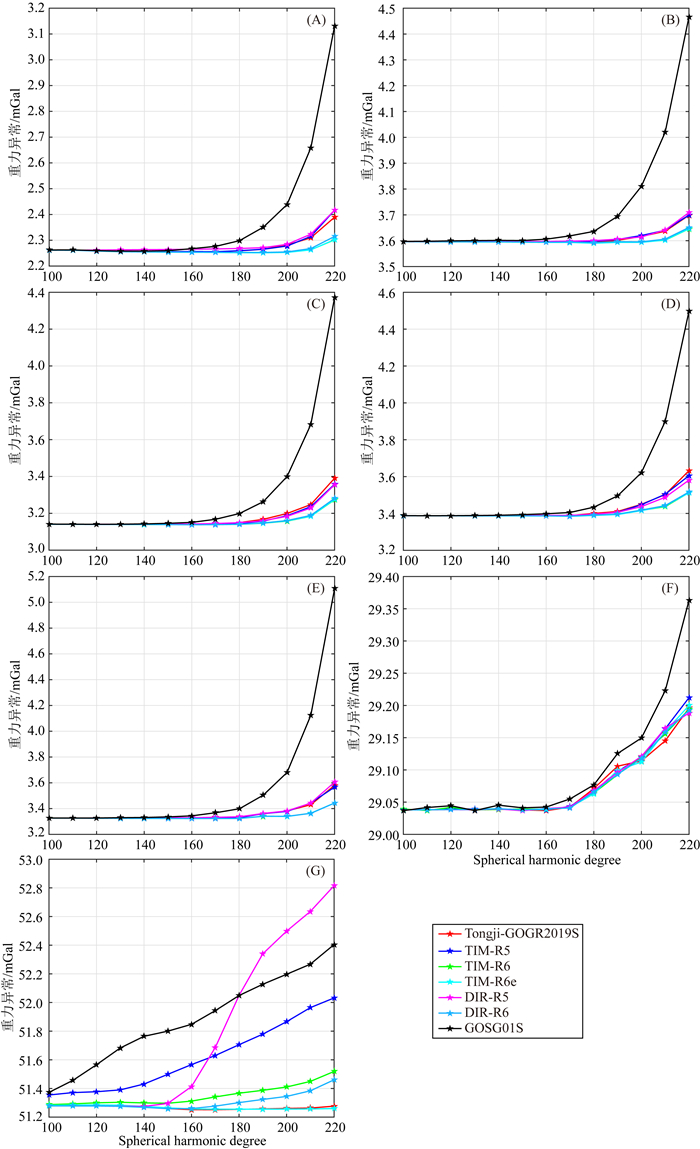
图 6
利用DTU15海洋重力异常数据检核各模型精度统计结果
Figure 6.
Statistical results of different models to DTU15 ocean gravity anomaly data
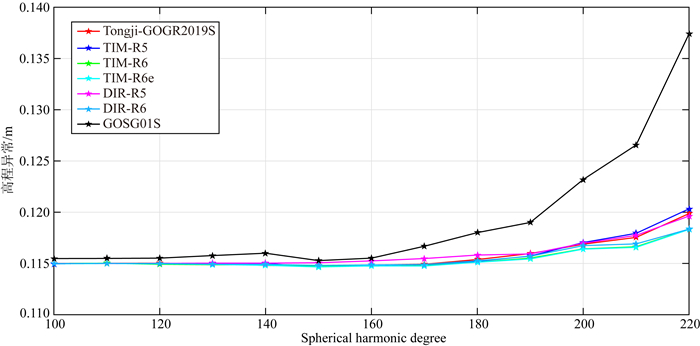
图 7
采用EGG2015似大地水准面数据检核各模型精度统计结果
Figure 7.
Statistical results of different models to EGG2015 model
表 1
Tongji-GOGR2019S模型信息
Table 1.
The information of Tongji-GOGR2019S model
项目 内容 GOCE数据 2011-02—2013-10,约24个月 GRACE数据 2003-01—2016-07,约13.5 a 反演方法 直接法 GOCE梯度滤波 8阶IIR, 5 ~ 41 mHz 正则化方法 无 先验模型 300阶次GIF48模型  下载: 导出CSV
表 2
用美国GNSS水准数据检核各模型精度统计结果(单位:m)
Table 2.
Statistical results of different models to GNSS/levelling data in USA(unit: m)
截断阶次 Tongji-GOGR2019S TIM-R5 TIM-R6 TIM-R6e DIR-R5 DIR-R6 GOSG01S 180 0.222 0.223 0.222 0.222 0.223 0.222 0.223 190 0.224 0.224 0.224 0.223 0.224 0.224 0.226 200 0.224 0.225 0.224 0.224 0.224 0.224 0.231 210 0.224 0.228 0.226 0.225 0.225 0.225 0.233 220 0.228 0.229 0.228 0.228 0.227 0.227 0.244
下载: 导出CSV
表 3
用墨西哥GNSS水准数据检核各模型精度统计结果(单位:m)
Table 3.
Statistical results of different models to GNSS/levelling data in Mexico (unit: m)
截断阶次 Tongji-GOGR2019S TIM-R5 TIM-R6 TIM-R6e DIR-R5 DIR-R6 GOSG01S 180 0.263 0.264 0.263 0.263 0.266 0.264 0.271 190 0.264 0.264 0.264 0.264 0.266 0.265 0.273 200 0.266 0.268 0.267 0.267 0.270 0.268 0.282 210 0.271 0.273 0.271 0.270 0.274 0.273 0.287 220 0.273 0.275 0.273 0.273 0.277 0.275 0.294
下载: 导出CSV
表 4
用加拿大GNSS水准数据检核各模型精度统计结果(单位:m)
Table 4.
Statistical results of different models to GNSS/levelling data in Canada (unit: m)
截断阶次 Tongji-GOGR2019S TIM-R5 TIM-R6 TIM-R6e DIR-R5 DIR-R6 GOSG01S 180 0.248 0.246 0.248 0.248 0.246 0.247 0.249 190 0.247 0.247 0.248 0.248 0.246 0.247 0.256 200 0.248 0.247 0.248 0.248 0.246 0.248 0.260 210 0.250 0.246 0.248 0.248 0.245 0.248 0.267 220 0.252 0.250 0.251 0.251 0.249 0.250 0.271
下载: 导出CSV
表 5
DTU15海洋重力异常数据全球区域划分一览表
Table 5.
Marine gravity anomaly data table from DTU15
区域代码 区域范围 纬度 经度 A 0°~45° 150°~225° B 0°~60° 315°~340° C -60°~0° 180°~270° D -60°~0° 330°~360° E -60°~-10° 60°~105° F -66°~-76° 300°~330° G 75°~89° 120°~240°
下载: 导出CSV
-
Andersen O B, Knudsen P, Kenyon S, et al. 2019. Evaluation of the global altimetric marine gravity field DTU15: using marine gravity and GOCE satellite gravity.//Freymueller J, Sánchez L eds. International Symposium on Advancing Geodesy in a Changing World. Cham: Springer, 77-81.
Becker S, Brockmann J M, Schuh W D. 2014. Mean dynamic topography estimates purely based on GOCE gravity field models and altimetry. Geophysical Research Letters, 41(6):2063-2069, doi:10.1002/2014GL059510.
Brockmann J M, Zehentner N, Höck E, et al. 2014. EGM-TIM-RL05:An independent geoid with centimeter accuracy purely based on the GOCE mission. Geophysical Research Letters, 41(22):8089-8099, doi:10.1002/2014GL061904.
Brockmann J M, Schubert T, Mayer-Gürr T, et al. 2019. The Earth's gravity field as seen by the GOCE satellite:an improved sixth release derived with the time-wise approach(GO_CONS_GCF_2_TIM_R6). GFZ Data Services. http://doi.org/10.5880/ICGEM.2019.003. doi: 10.5880/ICGEM.2019.003
Bruinsma S L, Förste C, Abrikosov O, et al. 2013. The new ESA satellite-only gravity field model via the direct approach. Geophysical Research Letters, 40(14):3607-3612, doi:10.1002/grl.50716.
Bruinsma S L, Förste C, Abrikosov O, et al. 2014. ESA's satellite-only gravity field model via the direct approach based on all GOCE data. Geophysical Research Letters, 41(21):7508-7514, doi:10.1002/2014GL062045.
Chen Q J, Shen Y Z, Chen W, et al. 2016. An improved GRACE monthly gravity fleld solution by modeling the non-conservative acceleration and attitude observation errors. Journal of Geodesy, 90(6):503-523, doi:10.1007/s00190-016-0889-6.
Chen Q J, Shen Y Z, Francis O, et al. 2018. Tongji-Grace02s and Tongji-Grace02k:high-precision static GRACE-only global Earth's gravity field models derived by refined data processing strategies. Journal of Geophysical Research:Solid Earth, 123(7):6111-6137, doi:10.1029/2018JB015641.
Denker H. 2016. A new European gravimetric (quasi)geoid EGG2015.//paper presented at the IAG Symposium on Gravity, Geoid and Height Systems 2016 (GGHS2016). Thessaloniki, Greece.
Förste C, Bruinsma S L, Abrikosov O, et al. 2014. EIGEN-6C4 The latest combined global gravity field model including GOCE data up to degree and order 2190 of GFZ Potsdam and GRGS Toulouse. GFZ Data Services. http://doi.org/10.5880/icgem.2015.1. doi: 10.5880/icgem.2015.1
Förste C, Abrykosov O, Bruinsma S L, et al. 2019. ESA's Release 6 GOCE gravity field model by means of the direct approach based on improved filtering of the reprocessed gradients of the entire mission (GO_CONS_GCF_2_DIR_R6). GFZ Data Services. http://doi.org/10.5880/ICGEM.2019.004. doi: 10.5880/ICGEM.2019.004
Fuchs M J, Bouman J, Broerse T, et al. 2013. Observing coseismic gravity change from the Japan Tohoku-Oki 2011 earthquake with GOCE gravity gradiometry. Journal of Geophysical Research:Solid Earth, 118(10):5712-5721, doi:10.1002/jgrb.50381.
Gatti A, Reguzzoni M. 2017. GOCE gravity field model by means of the space-wise approach (release R5). GFZ Data Services. http://doi.org/10.5880/icgem.2017.005. doi: 10.5880/icgem.2017.005
Gerlach C, Rummel R. 2013. Global height system unification with GOCE:a simulation study on the indirect bias term in the GBVP approach. Journal of Geodesy, 87(1):57-67, doi:10.1007/s00190-012-0579-y.
Gruber T. 2019. GOCE release 6 products and performance.//27th IUGG General Assembly. Montreal.
Hsu H Z, Lu Y, Zhong M, et al. 2012. Satellite gravity and its application to monitoring geophysical environmental change. Scientia Sinica Terrae (in Chinese), 42(6):843-853. doi: 10.1360/zd-2012-42-6-843
Huang Q. 2014. Recovery and application of gravity field model based on GOCE[Ph. D. thesis](in Chinese). Chengdu: Southwest Jiaotong University.
Kvas A, Mayer-Gürr T, Krauss S, et al. 2019. The satellite-only gravity field model GOCO06s. GFZ Data Services. http://doi.org/10.5880/ICGEM.2019.002. doi: 10.5880/ICGEM.2019.002
Liang J Q. 2016. Gravity Field Recovery Basing on GOCE Observation Data[Master's thesis] (in Chinese). Shanghai: Tongji University.
Liu X G. 2011. Theory and methods of the Earth's gravity field model recovery from GOCE data[Ph. D. thesis] (in Chinese). Zhengzhou: PLA Information Engineering University.
Lu B, Luo Z C, Zhong B, et al. 2018. The gravity field model IGGT_R1 based on the second invariant of the GOCE gravitational gradient tensor. Journal of Geodesy, 92(5):561-572, doi:10.1007/s00190-017-1089-8.
Luo Z C, Zhou H, Zhong B, et al. 2015. Dynamic integral approach based on weighted multi-direction observations for inversion of the earth's gravity field. Chinese Journal of Geophysics (in Chinese), 58(9):3061-3071, doi:10.6038/cjg20150904.
Pail R, Goiginger H, Schuh W D, et al. 2010. Combined satellite gravity field model GOCO01S derived from GOCE and GRACE. Geophysical Research Letters, 37(20):L20314, doi:10.1029/2010GL044906.
Pail R, Bruinsma S, Migliaccio F, et al. 2011. First GOCE gravity field models derived by three different approaches. Journal of Geodesy, 85(11):819-843, doi:10.1007/s00190-011-0467-x.
Reguzzoni M, Tselfes N. 2009. Optimal multi-step collocation:application to the space-wise approach for GOCE data analysis. Journal of Geodesy, 83(1):13-29, doi:10.1007/s00190-008-0225-x.
Schall J, Eicker A, Kusche J. 2014. The ITG-Goce02 gravity field model from GOCE orbit and gradiometer data based on the short arc approach. Journal of Geodesy, 88(4):403-409, doi:10.1007/s00190-014-0691-2.
Siemes C, Rexer M, Schlicht A, et al. 2019. GOCE gradiometer data calibration. Journal of Geodesy, 93(9):1603-1630, doi:10.1007/s00190-019-01271-9.
Su Y, Fan D M, Pu X G, et al. 2018. New static gravity field model SWJTU-GOGR01S derived from GOCE data and GRACE normal equation. Geomatics and Information Science of Wuhan University (in Chinese), 43(3):457-463. http://www.wanfangdata.com.cn/details/detail.do?_type=perio&id=whchkjdxxb201803019
Wan X Y, Yu J H, Zeng Y Y. 2012. Frequency analysis and filtering processing of gravity gradients data from GOCE. Chinese Journal of Geophysics (in Chinese), 55(9):2909-2916, doi:10.6038/j.issn.0001-5733.2012.09.010.
Wu H, Müller J, Brieden P. 2016. The IfE global gravity field model from GOCE-only observations.//International Symposium on Gravity, Geoid and Height Systems. Thessaloníki, Greece.
Xu T H, He K F. 2009. Outlier snooping based on the test statistic of moving windows and its applications in GOCE data preprocessing. Acta Geodaetica et Cartographica Sinica (in Chinese), 38(5):391-396. http://www.wanfangdata.com.cn/details/detail.do?_type=perio&id=chxb200905003
Xu X Y, Zhao Y Q, Reubelt T, et al. 2017. A GOCE only gravity model GOSG01S and the validation of GOCE related satellite gravity models. Geodesy and Geodynamics, 8(4):260-272, doi:10.1016/j.geog.2017.03.013.
Yi W Y. 2012a. The Earth's gravity field from GOCE[Ph. D. thesis]. German: Technische Universität Mänchen.
Yi W Y. 2012b. An alternative computation of a gravity field model from GOCE. Advances in Space Research, 50(3):371-384, doi:10.1016/j.asr.2012.04.018.
Yi W Y, Rummel R, Gruber T. 2013. Gravity field contribution analysis of GOCE gravitational gradient components. Studia Geophysica et Geodaetica, 57(2):174-202, doi:10.1007/s11200-011-1178-8.
Yu J H, Wan X Y. 2012. Recovery of the gravity field from GOCE data by using the invariants of gradient tensor. Science China Earth Sciences, 56(7):1193-1199.
Zheng W, Xu H Z, Zhong M, et al. 2011. Accurate and rapid determination of GOCE Earth's gravitational field using time-space domain method approach associated with Kaula regularization. Chinese Journal of Geophysics (in Chinese), 54(1):14-21, doi:10.3969/j.issn.0001-5733.2011.01.003.
Zheng W, Xu H Z, Zhong M, et al. 2014. Research progress in satellite gravity gradiometry recovery. Journal of Geodesy and Geodynamics (in Chinese), 34(4):1-8. http://www.wanfangdata.com.cn/details/detail.do?_type=perio&id=dkxbydz201404001
Zhong B. 2010. Study on the determination of the Earth's gravity field from satellite gravimetry mission GOCE[Ph. D. thesis] (in Chinese). Wuhan: Wuhan University.
Zhou H, Xu C, Luo Z C, et al. 2019. HUST-GOGRA2018s:A new gravity field model derived from the combination of GRACE and GOCE data. Terrestrial, Atmospheric and Oceanic Sciences, 30(1):97-109, doi:10.3319/TAO.2018.11.02.01.
Zingerle P, Brockmann J M, Pail R, et al. 2019. The polar extended gravity field model TIM_R6e. GFZ Data Services, http://doi.org/10.5880/ICGEM.2019.005. doi: 10.5880/ICGEM.2019.005
黄强. 2014.基于GOCE卫星的重力场模型反演及应用[博士论文].成都: 西南交通大学.
梁建青. 2016.基于GOCE观测数据的重力场反演[硕士论文].上海: 同济大学.
刘晓刚. 2011. GOCE卫星测量恢复地球重力场模型的理论与方法[博士论文].郑州: 解放军信息工程大学.
罗志才, 周浩, 钟波等. 2015.顾及多方向观测值权比反演地球重力场的动力积分法.地球物理学报, 58(9):3061-3071, doi:10.6038/cjg20150904. http://www.geophy.cn/CN/abstract/abstract11785.shtml
苏勇, 范东明, 蒲星钢等. 2018.联合GOCE卫星数据和GRACE法方程确定SWJTU-GOGR01S全球重力场模型.武汉大学学报(信息科学版), 43(3):457-463. http://www.wanfangdata.com.cn/details/detail.do?_type=perio&id=whchkjdxxb201803019
万晓云, 于锦海, 曾艳艳. 2012. GOCE引力梯度的频谱分析及滤波.地球物理学报, 55(9):2909-2916, doi:10.6038/j.issn.0001-5733.2012.09.010. http://www.geophy.cn/CN/abstract/abstract8929.shtml
许厚泽, 陆洋, 钟敏等. 2012.卫星重力测量及其在地球物理环境变化监测中的应用.中国科学:地球科学, 42(6):843-853. http://www.wanfangdata.com.cn/details/detail.do?_type=perio&id=zgkx-cd201206004
徐天河, 贺凯飞. 2009.移动开窗检验法及其在GOCE数据粗差探测中的应用.测绘学报, 38(5):391-396. http://www.wanfangdata.com.cn/details/detail.do?_type=perio&id=chxb200905003
于锦海, 万晓云. 2012.利用引力梯度不变量解算的GOCE引力场模型.中国科学:地球科学, 42(9):1450-1458. http://www.wanfangdata.com.cn/details/detail.do?_type=perio&id=zgkx-cd201209013
郑伟, 许厚泽, 钟敏等. 2011.基于时空域混合法利用kaula正则化精确和快速解算GOCE地球重力场.地球物理学报, 54(1):14-21, doi:10.3969/j.issn.0001-5733.2011.01.003. http://www.geophy.cn/CN/abstract/abstract7713.shtml
郑伟, 许厚泽, 钟敏等. 2014.卫星重力梯度反演研究进展.大地测量与地球动力学, 34(4):1-8. http://www.wanfangdata.com.cn/details/detail.do?_type=perio&id=dkxbydz201404001
钟波. 2010.基于GOCE卫星重力测量技术确定地球重力场的研究[博士论文].武汉: 武汉大学.
-
图(7)
表(5)
计量
- 文章访问数:
- PDF下载数:
- 施引文献: 0